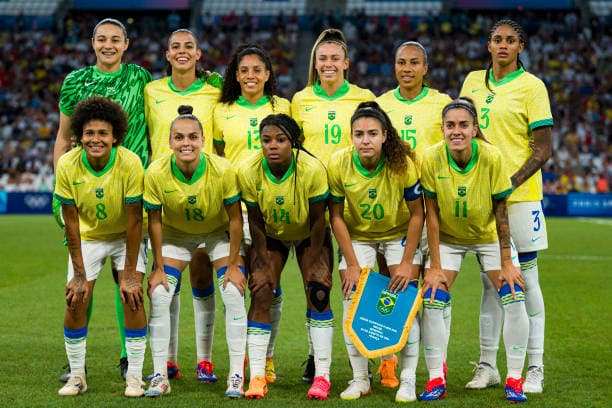
The Women’s World Cup is now just over a year away, and hosts Brazil are beginning their journey towards the showpiece event.
It is a moment that promises to be historic for the nation, as Brazil prepare to host the Women’s World Cup for the very first time. With the eyes of the footballing world set to fall on them, they will be hoping to give their home fans memories that will last a lifetime.
The Brazilian side will begin their 2026 campaign with fixtures against Costa Rica, Venezuela and Mexico over the coming week, as preparations continue ahead of the World Cup on home soil.
Brazil enjoyed a strong 2025, suffering defeat just three times in 15 matches. Their year was highlighted by lifting the Copa America title in August 2025, defeating Colombia on penalties in the final to secure their ninth continental crown.
That triumph was followed by further positive results, including victories over England and Italy in October, underlining their ability to compete against Europe’s elite.
However, there were also reminders of the work still to be done. They suffered a 3-1 defeat away to Norway before responding in emphatic fashion in their most recent outing, thumping Portugal 5-0 on their own soil.
With momentum, confidence and belief growing, Brazil will now look to carry that form into 2026 as they continue their long build-up towards a historic World Cup on home soil.
The first squad of the year
The squad features 12 domestic-based players, seven of whom represented Corinthians at the recent Intercontinental Club Cup, where they were narrowly defeated by Arsenal in the final.
The remainder of the squad is made up of players based in Europe, Mexico and the United States.
One of the domestic-based players, Tamires, has earned 80 caps for the Selecao. However, she has not featured since the 2024 Olympics, where Brazil went on to win the silver medal.
Her absence was due to a seven-month recovery period following ankle ligament surgery, which kept her out of action for an extended spell.
Her recall is not simply sentimental, but a tactical decision. She has been brought back to provide experience, leadership and stability to a defensive unit that is gradually transitioning, particularly with younger defenders such as Tarciane and Lauren Leal coming into the fold.
Lauren was also part of the 2024 Olympic squad and had endured a recent hiatus from international football, but now returns for this window. Her recall comes off the back of strong club form, having been named Player of the Month in December for Atletico Madrid.
Manchester City’s Kerolin is enjoying a strong season at club level. During the 2025/26 campaign, she has scored seven goals in nine matches whilst also providing four assists, underlining her importance to the side’s attacking output.
Her standout performance came in the title-deciding clash against Chelsea, where Manchester City secured a dominant 5-1 victory, with the Brazilian netting a superb hat-trick on the biggest stage.
She will now be hoping to carry that momentum onto the international stage, seeking to add to her 12 international goals.
World Cup on home soil, why are Brazil opting to play away?
There is a clear reason why Arthur Elias and the CBF have chosen for Brazil to play away from home rather than remain in familiar surroundings.
He has explained that facing sides like Costa Rica and Mexico in their own stadiums is a deliberate psychological test for his players.
If Brazil were to play only at home, they would remain in their comfort zone. Instead, by travelling to hostile environments such as Alajuela and Mexico City, the squad is exposed to high-energy crowds, unfamiliar conditions, as well as, external pressure. This helps develop the siege mentality required to cope with the enormous expectations that will come with hosting the World Cup in 2027.
Playing at home in friendlies would naturally favour Brazil, both in terms of crowd support and control on the pitch. However, that environment does not fully replicate the emotional and psychological intensity of tournament football.
Elias is applying a clear principle, preparation must go beyond tactics and technical ability. It must also build mental resilience. By placing his players in uncomfortable situations now, he is ensuring they are better equipped to handle pressure further down the line.
This is a deliberate part of Brazil’s preparation. Competing in these demanding environments will push the players’ fitness levels and endurance to their limits, ensuring they are physically stronger and better conditioned when they return to play in their own host cities, such as Rio de Janeiro and Fortaleza, where conditions will feel far more manageable by comparison.
Also, playing in cities like Toluca and Mexico City, where the altitude is much higher, will naturally push the players’ stamina and fitness to another level. Toluca, for example, sits at around 2,660 metres above sea level, meaning the air is thinner and matches become far more physically demanding.
This type of environment forces players to adapt, something that will benefit them when they return to playing in their host cities such as Rio de Janeiro and Fortaleza.
Read More: Vasco da Gama sack Fernando Diniz: The breaking point after Fluminense defeat
The three opponents also offer very different types of challenges.
Costa Rica are known for their physicality and defensive discipline, often sitting deep in a low block and forcing teams to break them down.
Venezuela provide a familiar South American test, offering a tactical battle against a side that understands Brazil’s style and intensity.
Then, of course, there is the match against Mexico, which will be played on Mexican soil in front of a large and hostile crowd, with the majority of supporters backing the home side.
This is exactly the type of environment Brazil need, forcing them out of their comfort zone and helping build the mentality required ahead of a World Cup on home soil, where expectations and pressure will be unlike anything they have experienced before.