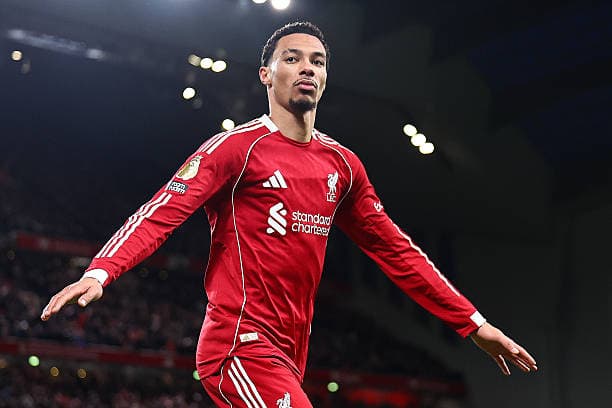
Liverpool may not be enjoying the best of times on the pitch and are enduring a difficult season by their usual standards.
However, one encouraging aspect has been the emerging link-up between Florian Wirtz and Hugo Ekitike.
Both players appear to have grown into their roles, but from the outset, it has been Ekitike who has hit the ground running, drawing comparisons to Fernando Torres and the impact he made during his early days at Anfield in the late noughties.
The evidence behind Steven Gerrard's quote
"He reminds me of Torres, this player, every time I watch him."
Liverpool legend Steven Gerrard told TNT Sports that Hugo Ekitike reminds him of Fernando Torres every time he watches him.
It is not just about the goals, such as the recent strike against Newcastle United that was almost identical to the one Torres scored on his Anfield debut against Chelsea, but also the way they play.
It is the movement, the intelligence off the ball, and the ability to attack space. Both are excellent at running in behind defenders, and Torres, in his early Liverpool days, was a nightmare for teams playing with a high defensive line due to his sheer pace and ruthless finishing. Pace was his main weapon, before his finishing ability took centre stage.
Ekitike shares many of those traits. Like Torres, he arrived at Liverpool full of belief and confidence, carrying himself like the man meant to lead the line.
There have been differences in his path, however. The signing of Alexander Isak should have made it harder for Ekitike to establish himself as the clear number nine. With Isak struggling with injuries, Ekitike has taken that responsibility on his shoulders and looked comfortable doing so.
So far, he has not buckled under the pressure. Instead, he has embraced the role, looking comfortable carrying the expectations that come with being Liverpool’s number nine.
Both work best as part of a fluid attack. Torres and Gerrard linked up perfectly on countless occasions, almost instinctively, always knowing where the other would be.
A similar relationship is now building between Wirtz and Ekitike. From early on, the pair have looked in sync, constantly searching for each other, anticipating movements, and knowing where the next pass is going to land.
At times, it feels like their minds are interlinked, something that usually takes years to develop.
Ekitike vs Torres: The stats
The numbers back up the comparison, too. After 21 matches, Ekitike is averaging 0.67 goals per 90 minutes, compared to Torres’ 0.62.
Ekitike’s conversion rate is marginally higher at 19.6%, compared to Torres’ 15.3%, while their shot volume is also similar, with Ekitike averaging 3.4 shots per 90 minutes compared to Torres’ 4.1.
Where Torres edges it is in shot accuracy, registering 36.6% compared to Ekitike’s 32.4%.
As of early February 2026, Ekitike has scored 15 goals and provided four assists in 32 matches. Torres posted comparable numbers at a similar stage, with 18 goals and four assists.
What makes Ekitike’s output even more impressive is that he has achieved almost the same return while playing around 250 fewer minutes, largely due to rotation with Isak.
The differences
Despite their many similarities, there are also clear differences between the pair. Ekitike is more versatile, capable of operating either through the middle or off the left, a trait that likely stems from his exceptional dribbling ability.
He completes his dribbles at a success rate of 51.9%, compared to Torres’ 41.9%, showing Ekitike is more comfortable carrying the ball and functioning in different systems or positions.
Torres, however, was slightly more creative in the final third at this stage of his career, averaging 1.6 chances created per game compared to Ekitike’s 0.9.
Read More: Eclipsing legends: Florian Wirtz and Hugo Ekitike shatter long-standing Liverpool records
Another notable difference comes in the finishing balance. Torres was more two-footed, having scored four goals with his weaker foot at a similar point in his Liverpool career, while Ekitike has just one.
This highlights Torres’ natural instinct inside the box and his ability to finish chances in a variety of ways.
Conclusion
Ultimately, the comparisons between Ekitike and Torres are not just based on nostalgia or surface-level similarities. The numbers, the movement, and the confidence with which both arrived at Liverpool all point to genuine parallels in how they impact games.
Ekitike is not a carbon copy of Torres, and he does not need to be. He is a more modern forward, more flexible in his positioning and more involved in build-up play, while Torres at his peak was a ruthless, direct number nine whose pace terrified high defensive lines.
What matters most for Liverpool is that Ekitike has shown he can carry responsibility. When given the chance, he has stepped up rather than shrinking under the pressure of leading the line at Anfield, a burden that has broken many before him.
If he continues on this trajectory, developing his finishing balance and maintaining his confidence, Liverpool may not be looking at the next Torres, but they could well have found a forward capable of leading the line for years to come.